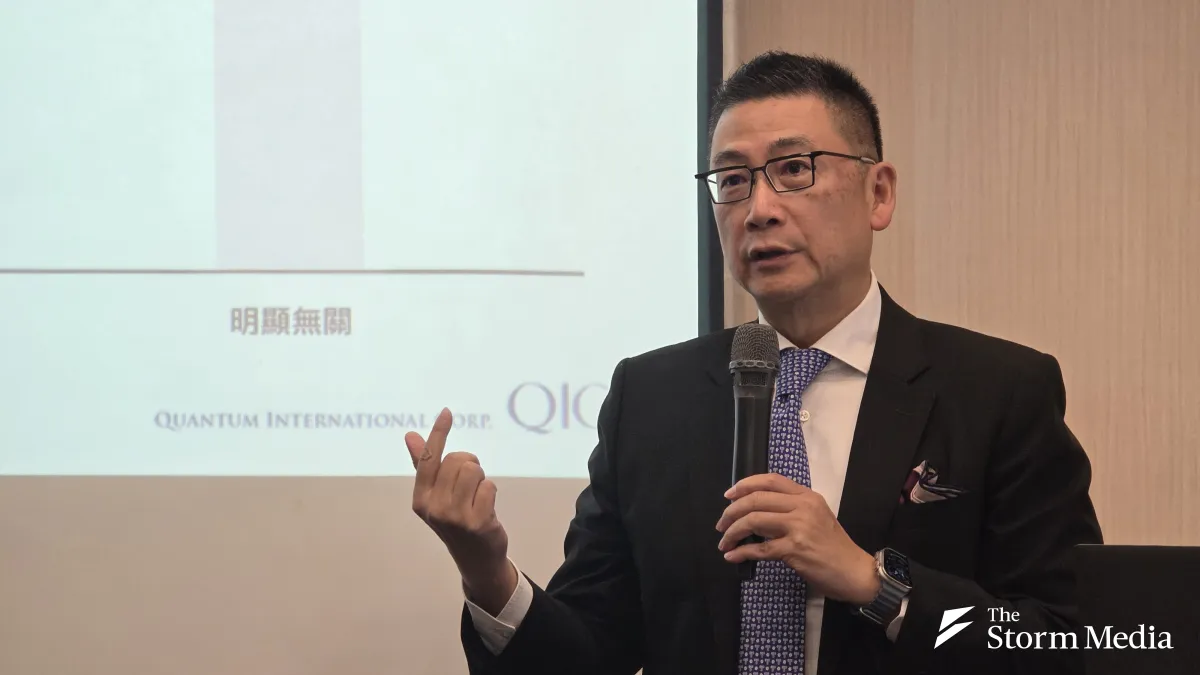
Taiwan's AI boom has already turned server rail maker King Slide Works and copper clad laminate supplier Elite Material into market heavyweights. On October 12, investment consultancy Quantitative Investment Consulting (QIC) released the QIC AI 500, a list of 500 Taiwanese listed companies outside the island's tech giants that it says could form the next wave of AI supply chain beneficiaries.
The list is aimed at international investors who know Taiwan mainly through TSMC and a handful of AI server assemblers. QIC's argument is that AI capital spending is now reaching deeper into the island's supply chain, touching equipment makers, power suppliers, materials firms, and even factory builders.
Twenty Small Firms Have Already Joined Taiwan's Tech Elite
QIC founder and CEO Alex Lee said 20 companies that were once relatively small have climbed into the T50, QIC's group of Taiwan's largest technology companies, since 2023. He cited King Slide, Elite Material, and chip test interface specialist WinWay Technology as examples.
Those three are past success stories, not members of the new list. The AI 500 instead looks for candidates further down the market cap ladder that could follow a similar path.
How QIC Screened 2,289 Listed Companies
QIC said its team reviewed 12 quarters of financial statements, earnings call materials, and other public disclosures from 2,289 companies outside the T50. The pool covered firms on the Taiwan Stock Exchange (TWSE), the Taipei Exchange (TPEx), and the TPEx emerging board, a pre-listing market for younger companies.
According to a tally of the spreadsheet QIC provided, 232 companies sit in Category A, labeled clear AI beneficiaries, while 268 fall into Category B, where the AI link is real but accounts for a small share of business. By market, 247 trade on the TWSE, 200 on the TPEx, and 53 on the emerging board.
Most are small. The list includes 69 mid caps worth $2 billion to $10 billion, 227 small caps worth $300 million to $2 billion, and 204 companies valued below $300 million. At the NT$31.68 per U.S. dollar rate used in QIC's presentation, the two key thresholds equal roughly NT$63.4 billion and NT$9.5 billion. Market values are as of September 18.
A Category B Label Does Not Prove AI Revenue
A QIC senior adviser said during a Q&A session that the research sorted companies by how closely their business and revenue tie to AI. It separates significant beneficiaries from companies with a smaller existing link and from those that only claim AI plans without revenue to back them up.
That nuance matters. Notes attached to some Category B entries say products have not shipped, are still in customer qualification, do not break out AI revenue, or benefit only indirectly through power and infrastructure demand. The AI 500 is better read as QIC's map of AI related businesses and potential beneficiaries than as proof that all 500 already earn AI income.
Two entries show the range. The list describes power management chip designer ANPEC Electronics as expecting server IC volumes to ramp up, while burn-in test equipment maker Zen Voce is noted as sampling products with no revenue contribution yet. Investors should check the date of each data point against later company disclosures.
Equipment, Cleanrooms, and Backup Power Widen the AI Map
Many names on the list do not make chips or servers at all. C SUN Mfg. is linked to AI through process equipment for advanced packaging and high end printed circuit boards, while Symtek Automation Asia supplies automation systems for semiconductors, PCB substrates, and advanced packaging. Both sell the tools customers need when they add capacity.
Factory construction is another channel. QIC included Hsinchu-based Jiu Han System Technology, which handles cleanroom construction and mechanical, electrical, and air conditioning integration for high tech plants, as an AI infrastructure beneficiary. Its inclusion reflects how AI chip and data center expansion also requires buildings and utilities.
Power and materials round out the picture. Sysgration made the list for battery backup units (BBU) used in AI servers. Adhesives maker Nan Pao Resins Chemical supplies UV release adhesives and grinding tape for semiconductor processes; QIC placed it in Category B, noting it already earns revenue from the business but at a small share.
QIC Urges Investors to Verify Shipments and Cash Flow
For any company on the list, QIC's research points investors to four questions: whether customer qualification is complete, whether products are actually shipping, whether the AI revenue share is disclosed, and whether growth turns into profit and cash flow. For indirect beneficiaries, investors also need to separate ordinary semiconductor, energy, or infrastructure work from demand that truly comes from AI.
Lee said the team chose companies conservatively. In his view, AI creates new growth opportunities, but what decides whether a company can expand is its ability to offer solutions customers need. He described the list as a starting point for research, not a guarantee that any company will repeat the success of King Slide or Elite Material.
QIC is presenting the research around its 20th QIC CEO Week, which held in person sessions in Hong Kong on October 13 and 14, with online sessions starting October 20. Of the 34 participating companies, 20 are on the AI 500. QIC said attending institutions manage more than $20 trillion in combined assets, about NT$633.6 trillion at the presentation's exchange rate. That figure reflects assets under management, not investment commitments from the forum, and the participant roster also includes biotech, consumer, and unlisted companies outside the AI 500.